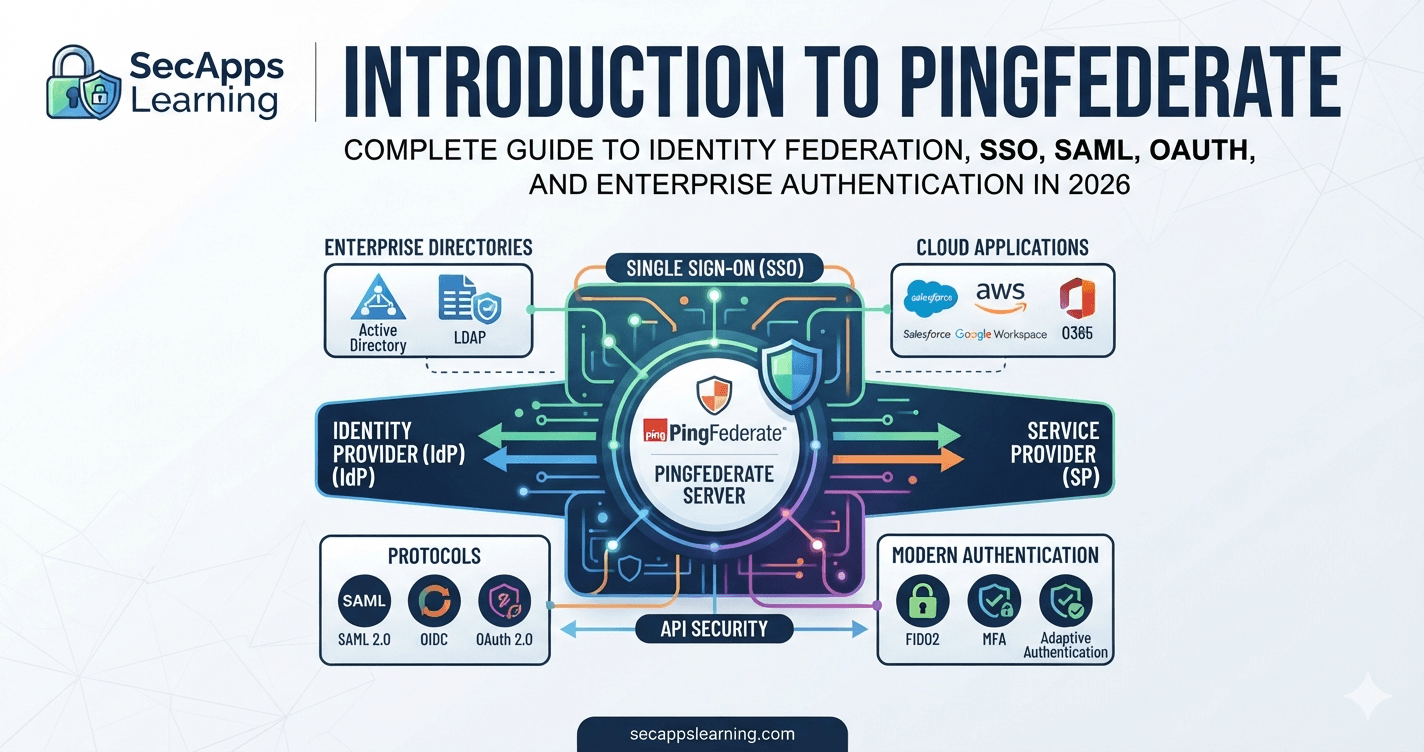
Modern enterprises operate in a world where employees, customers, vendors, and business partners access applications from multiple locations and across different domains. Managing identities securely while maintaining a seamless user experience has become one of the biggest challenges for organizations. This is where PingFederate plays a critical role.
PingFederate is an enterprise federation server and identity bridge designed to provide secure user authentication and standards-based Single Sign-On (SSO) for employee, partner, and customer identities. It enables organizations to implement identity federation across domains using industry-standard protocols such as SAML, OAuth, OpenID Connect (OIDC), WS-Federation, WS-Trust, and SCIM.
As organizations continue to adopt cloud applications, Software as a Service (SaaS) platforms, APIs, and hybrid environments, PingFederate has emerged as one of the leading identity federation solutions for implementing secure access management at scale.
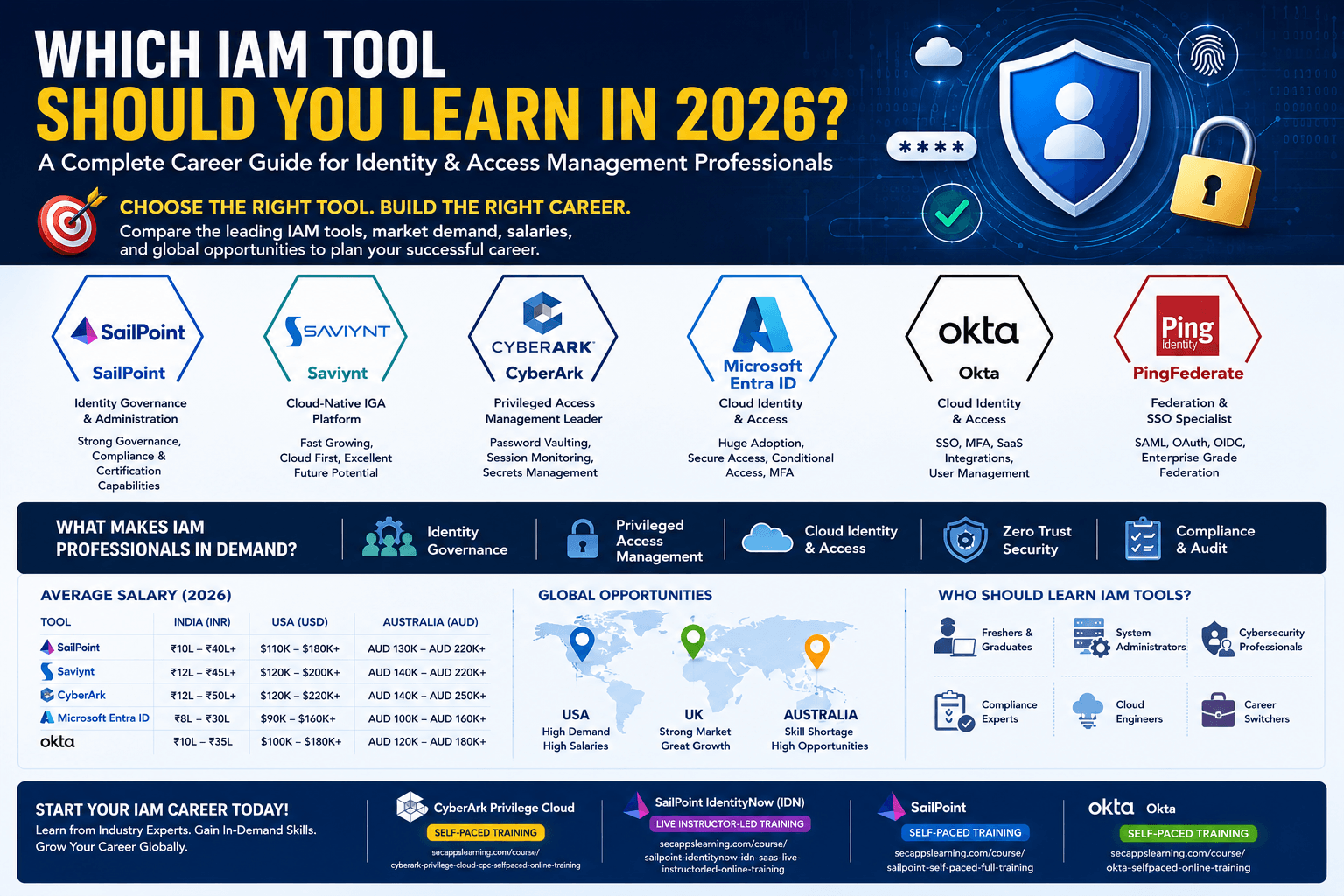
If you are exploring Identity and Access Management (IAM) as a career path, you may also find our guide on Which IAM Tool Should You Learn in 2026? useful for understanding the broader IAM ecosystem.
PingFederate is an enterprise-grade identity federation platform that allows organizations to exchange identity information securely across multiple domains. It serves as both an Identity Provider (IdP) and Service Provider (SP), making it one of the most flexible federation solutions available for browser-based Single Sign-On implementations.
At its core, PingFederate enables:
PingFederate supports outbound and inbound federation use cases and can operate as:
Unlike traditional authentication systems that rely on multiple passwords across applications, PingFederate allows organizations to establish trust relationships between systems, enabling users to authenticate once and gain access to multiple applications securely.
Identity federation refers to the secure exchange of identity information between organizations or domains. Rather than maintaining duplicate user accounts across multiple systems, identity federation enables one trusted organization to authenticate users on behalf of another.
For example:
This model provides several benefits:
Identity federation becomes particularly important when organizations expand through mergers, acquisitions, or maintain separate user repositories across business units.
Single Sign-On (SSO) is one of PingFederate's primary capabilities.
Browser-based SSO enables users to authenticate once and seamlessly access multiple applications across different domains without repeatedly entering credentials.
PingFederate supports several standards for SSO implementation, including:
A typical SSO flow looks like this:
This standards-based approach ensures interoperability between cloud providers, enterprise applications, and partner organizations.
Understanding Identity Providers and Service Providers is fundamental to working with PingFederate.
An Identity Provider authenticates users and issues identity information.
Examples include:
The IdP is responsible for:
A Service Provider consumes identity information provided by the IdP.
Examples include:
The SP trusts the IdP to authenticate users and grants access based on received assertions or tokens.
One of PingFederate's most powerful capabilities is functioning as a federation hub.
Organizations often work with multiple partners using different federation protocols. Supporting each integration individually increases complexity and administrative overhead.
A federation hub simplifies this challenge by acting as a central identity broker.
For example:
PingFederate bridges these protocols through a centralized architecture, reducing implementation effort and simplifying administration.
Benefits of using PingFederate as a federation hub include:
Security Assertion Markup Language (SAML) remains one of the most widely adopted federation standards.
SAML consists of several building blocks:
Assertions are XML documents generated by an IdP and sent to an SP.
They typically include:
Bindings define how SAML messages are transported.
PingFederate supports:
Profiles define how SAML specifications are implemented for specific use cases.
Examples include:
Metadata provides standardized configuration information between federation partners.
Metadata files include:
Authentication context provides information about how users authenticated.
Examples:
Authentication context helps Service Providers make authorization decisions and meet compliance requirements.
PingFederate supports multiple browser-based SSO scenarios.
In this model:
POST responses are digitally signed to ensure authenticity and integrity.
Browser Artifact uses an artifact rather than transferring the entire assertion through the browser.
The process involves:
This method reduces exposure of assertion data in browser traffic.
Service Provider-initiated SSO is one of the most common implementations in enterprise environments.
The process works as follows:
PingFederate supports several SP-initiated variations, including:
Each variation uses different combinations of transport mechanisms and bindings to accommodate diverse enterprise requirements.
PingFederate provides extensive support for SAML 2.0.
Major capabilities include:
SAML 2.0 remains the preferred federation protocol for many enterprises due to its maturity and interoperability across cloud providers and enterprise applications.
Single Logout allows users to terminate sessions across multiple applications simultaneously.
Without SLO:
With SLO:
This improves security and reduces risks associated with orphaned sessions.
Modern application architectures increasingly rely on OAuth 2.0 and OpenID Connect.
PingFederate can function as:
OAuth focuses on authorization.
It enables:
OpenID Connect extends OAuth by adding authentication capabilities.
It introduces:
Together, OAuth and OIDC form the foundation of modern API and cloud authentication strategies.
PingFederate supports WS-Federation Passive Requestor Profile, enabling interoperability with Microsoft environments such as Active Directory Federation Services (ADFS).
WS-Federation provides:
The process typically involves:
This capability makes PingFederate an excellent choice for organizations integrating with Microsoft ecosystems.
System for Cross-domain Identity Management (SCIM) standardizes user provisioning across systems.
PingFederate supports:
SCIM 1.1
SCIM 2.0
SCIM enables automated user lifecycle management, reducing administrative effort and improving consistency across environments.
Account linking enables users with accounts across multiple systems to authenticate once while maintaining existing accounts.
Consider the following scenario:
Once linked, users no longer need to manage multiple credentials across applications.
Account linking is particularly useful for:
PingFederate supports integration with Web Services Security (WSS).
WSS provides:
Supported token profiles include:
SSL/TLS is commonly used alongside WSS to provide secure communication channels.
Security remains a foundational component of PingFederate.
PingFederate uses:
These capabilities help organizations meet regulatory and compliance requirements.
PingFederate provides extensive integration support for:
The platform includes integration kits and SDKs for implementing "first-mile" and "last-mile" integrations.
First-mile integrations focus on:
Last-mile integrations focus on:
Organizations can explore more than 1,800 integrations available through Ping Identity's ecosystem.
If you are interested in understanding how identity solutions integrate with privileged access systems, read our article on Integrating CyberArk, SailPoint, and Okta.
PingFederate ships with several built-in adapters, including:
These adapters simplify common authentication scenarios while supporting adaptive authentication and multi-factor authentication requirements.
Authentication selectors enable dynamic authentication decisions.
Examples include:
Selectors help organizations implement adaptive authentication strategies based on:
PingFederate offers enterprise-ready deployment capabilities.
All federation configurations are managed from a single administrative console.
This includes:
PingFederate creates a centralized "identity doorway" through which all identity information flows.
PingFederate supports deployment behind:
Audit and logging capabilities support:
Identity and Access Management continues to be one of the fastest-growing technology domains.
Organizations worldwide are adopting:
PingFederate sits at the center of these initiatives.
Professionals with PingFederate expertise often work in roles such as:
Pairing PingFederate with solutions such as SailPoint and CyberArk can significantly enhance career opportunities. You can explore our related resources:
PingFederate has established itself as one of the industry's leading identity federation platforms by providing secure, standards-based authentication across cloud, mobile, SaaS, and on-premises environments.
Its support for SAML, OAuth, OpenID Connect, WS-Federation, WS-Trust, SCIM, and extensive enterprise deployment capabilities makes it an ideal solution for organizations seeking to modernize authentication and identity management.
From Identity Providers and Service Providers to federation hubs and authorization servers, PingFederate offers a comprehensive platform for implementing secure Single Sign-On and identity federation at enterprise scale.
As businesses continue to embrace digital transformation, professionals skilled in PingFederate will remain in high demand across IAM, cybersecurity, and cloud security domains.
Your email address will not be published. Required fields are marked*
 August 28 2026
 July 26 2026
 Explained Architecture, Plugins, Connector Management, Hardening and Complete Credential Rotation Guide (2026).png) July 24 2026
July 24 2026
July 24 2026
July 24 2026
.png) July 17 2026
July 17 2026
 July 16 2026
 July 10 2026
 July 09 2026
 July 05 2026
 — Complete Vault, DR, Cluster & Distributed Upgrade Handbook-.png) July 03 2026
July 03 2026
 vs Central Credential Provider (CCP) Complete Guide to Installation, Architecture, Licensing, SDKs, ASCP & Best Practices (2026)-.png) July 01 2026
July 01 2026
.png) June 30 2026
June 30 2026
 June 25 2026
 June 24 2026
.png) June 10 2026
June 10 2026
 June 09 2026
 – Complete Architecture, Deployment, HA, DR & Best Practices Guide 2026.png) June 06 2026
June 06 2026
 Certification Guide 2026 by SL.png) June 04 2026
June 04 2026
 Complete Guide 2026 – Identity Protection, Identity Threat Detection, AI-Powered Security Monitoring, Response Playbooks, and ISI Migration.png) June 02 2026
June 02 2026
 May 30 2026
 Complete Guide – Architecture, Security, User Provisioning & Identity Governance.png) May 29 2026
May 29 2026
 Complete Guide – IdentityIQ, Identity Security Cloud (ISC), Certification, Architecture & Career Roadmap.png) May 27 2026
May 27 2026
 Complete Getting Started Guide – Architecture, Configuration & Real-World Implementation.png) May 26 2026
May 26 2026
 – Complete Comparison 2026.png) May 24 2026
May 24 2026
 May 22 2026
 May 21 2026
 vs Privileged Session Manager (PSM) Complete 2026 Guide.png) May 20 2026
May 20 2026
 May 19 2026
.png) May 18 2026
May 18 2026
.png) May 17 2026
May 17 2026
 The Complete Beginner to Advanced Guide to Ethical Hacking.png) May 15 2026
May 15 2026
 May 15 2026
 May 14 2026
 by SecApps Learning.png) May 14 2026
May 14 2026
 May 13 2026
 (1).png) May 12 2026
May 12 2026
.png) May 11 2026
May 11 2026
 May 10 2026
 May 10 2026
 May 08 2026
.png) May 07 2026
May 07 2026
.png) May 06 2026
May 06 2026
.png) May 06 2026
May 06 2026
 Complete Guide (2026).png) May 05 2026
May 05 2026
.png) May 05 2026
May 05 2026
 (1).png) May 04 2026
May 04 2026
.png) May 03 2026
May 03 2026
.png) May 01 2026
May 01 2026
.png) May 01 2026
May 01 2026
.png) April 30 2026
April 30 2026
.png) April 29 2026
April 29 2026
.png) April 28 2026
April 28 2026
.png) April 27 2026
April 27 2026
 System Health, Safe Management, Platform & Master Policy Explained.png) April 26 2026
April 26 2026
 April 20 2026
.png) April 19 2026
April 19 2026
.png) April 17 2026
April 17 2026
.png) April 16 2026
April 16 2026
.png) April 15 2026
April 15 2026
 April 14 2026
 April 10 2026
 April 09 2026
 April 08 2026
 April 07 2026
 July 31 2025
 May 01 2026
 December 26 2024
 December 15 2024
.jpeg) December 08 2024
December 08 2024
 May 01 2026
 October 29 2024
 October 19 2024
 October 15 2024
 October 07 2024
 September 30 2024
 September 23 2024
 September 16 2024
 May 04 2026
 August 27 2024
 August 27 2024
 August 21 2024
 August 19 2024
 May 01 2026
 May 10 2024
 May 08 2024
 May 01 2026
 April 30 2024
.jpg) April 29 2024
April 29 2024
 April 25 2024
 April 22 2024
 April 12 2024
 April 05 2024
 March 30 2024
 May 01 2026
 March 27 2024
 March 27 2024
 March 11 2024
 March 07 2024
 February 29 2024
.jpg) May 01 2026
May 01 2026
 January 24 2024
 January 20 2024
 January 20 2024
 January 20 2024
 January 20 2024
 January 03 2024
 January 03 2024
 January 03 2024
 January 03 2024
Copyright 2022 SecApps Learning. All Right Reserved

Comments ()