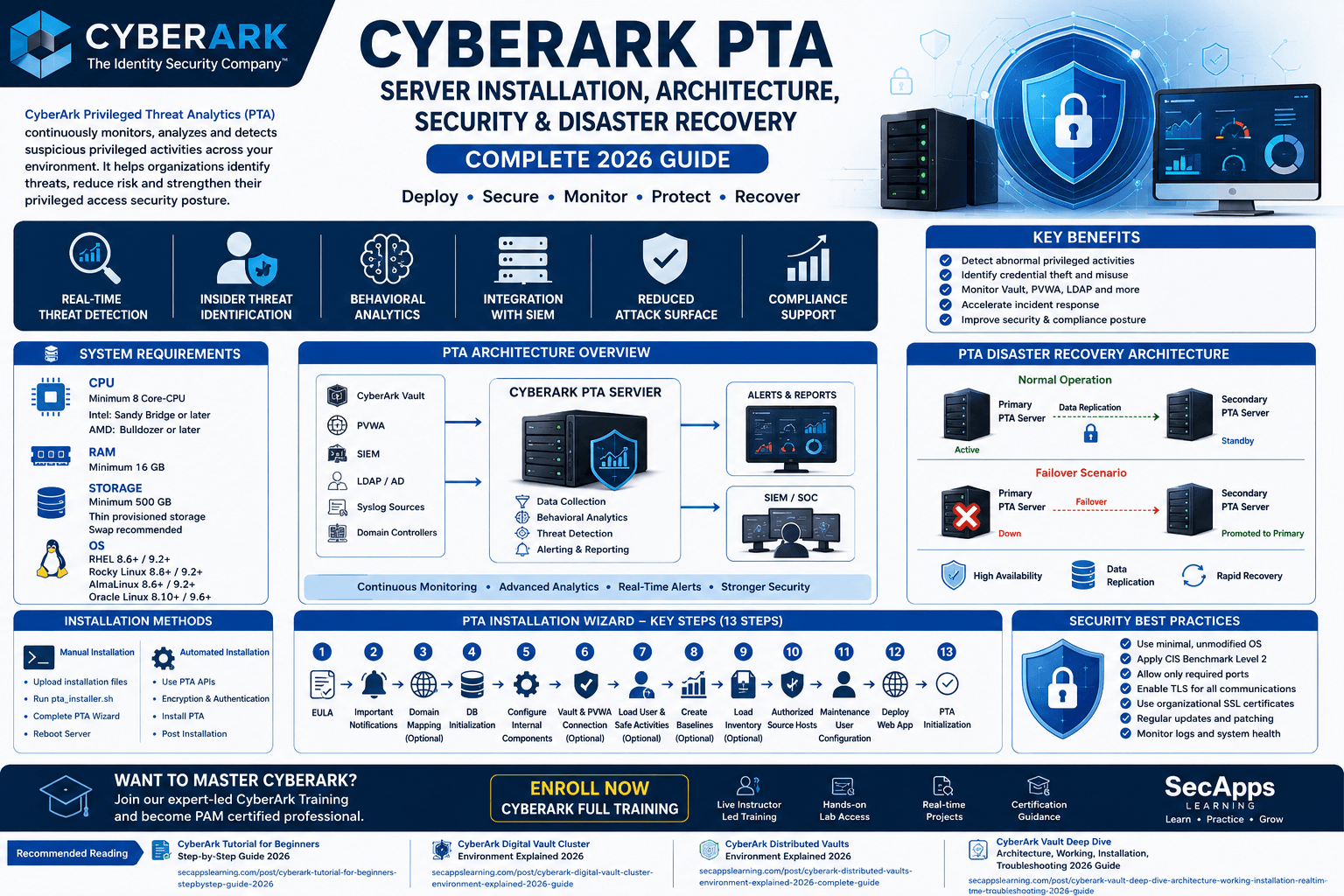
In modern cybersecurity environments, privileged accounts are among the most targeted assets by attackers. Organizations deploy Privileged Access Management (PAM) solutions to secure privileged credentials, monitor privileged sessions, and control sensitive access. However, protecting privileged credentials alone is not enough. Organizations also need intelligent threat analytics to detect suspicious privileged activities in real time.
This is where CyberArk Privileged Threat Analytics (PTA) becomes critical.
CyberArk PTA continuously monitors privileged account activities, analyzes behavioral patterns, detects anomalies, and alerts organizations about potential cyber threats, insider attacks, credential misuse, and lateral movement attempts.
PTA acts like a specialized SIEM for privileged activity monitoring.
In this complete guide by SecApps Learning, we will cover:
■ PTA Server System Requirements
■ Supported Operating Systems
■ PTA Installation Methods
■ PTA Security Best Practices
■ PTA Certificates and TLS Configuration
■ PTA Integration with Vault and PVWA
■ PTA Disaster Recovery Architecture
■ PTA Troubleshooting
■ PTA Maintenance and Monitoring
■ PTA Installation Wizard Walkthrough
■ PTA DR Failover and Failback
If you are learning CyberArk or working on real-time PAM implementations, this guide will help you understand PTA from beginner to advanced level.
CyberArk Privileged Threat Analytics (PTA) is an advanced security analytics engine that monitors privileged account behavior and identifies malicious or suspicious activities.
PTA collects logs from:
■ CyberArk Vault
■ PVWA
■ SIEM tools
■ LDAP
■ Syslog sources
■ Domain Controllers
■ Organizational infrastructure
It then applies machine learning and behavioral analytics to identify:
■ Privileged access during unusual hours
■ Excessive access attempts
■ Suspicious IP usage
■ Credential theft indicators
■ Dormant account activity
■ Unauthorized privileged activity
■ Abnormal Safe access behavior
PTA significantly improves the security posture of organizations by providing proactive threat detection capabilities.
Traditional PAM solutions focus on password security and session management. PTA extends this by adding behavioral analytics and threat intelligence.
Key Benefits of PTA
■ Real-time threat detection
■ Insider threat identification
■ Behavioral analytics
■ Integration with SIEM platforms
■ Reduced attack surface
■ Detection of lateral movement attacks
■ Compliance support
■ Advanced privileged activity monitoring
Organizations using PTA gain visibility into privileged activities that are often invisible to traditional monitoring systems.
CyberArk strongly recommends using a dedicated server for PTA because PTA is performance sensitive and processes large volumes of security events.
Minimum PTA Server Requirements
CPU Requirements
■ Minimum 8 Core CPU
Supported x86_64 architecture:
■ Sandy Bridge or later Core processor
■ Tiger Lake or later Celeron/Pentium processor
■ Bulldozer or later processor
RAM Requirements
■ Minimum 16 GB RAM
Storage Requirements
■ Minimum 500 GB thin provisioned storage
CyberArk recommends enabling SWAP storage because PTA memory usage can fluctuate depending on the workload.
PTA must be installed only on minimal and unmodified operating systems.
Supported Linux Platforms
Red Hat Enterprise Linux (RHEL)
■ RHEL 8.6 or later
■ RHEL 9.2 or later
Rocky Linux
■ Rocky Linux 8.6 or later
■ Rocky Linux 9.2 or later
AlmaLinux
■ AlmaLinux 8.6 or later
■ AlmaLinux 9.2 or later
Oracle Linux (RHCK)
■ Oracle Linux 8.10 or later
■ Oracle Linux 9.6 or later
CyberArk requires PTA to run on a minimal operating system profile.
Reasons Include
Security
Additional software increases the attack surface.
Performance
PTA behaves like a mini-SIEM and requires optimized resources for real-time event processing.
Stability
Unsupported third-party software may create compatibility issues.
CyberArk explicitly recommends:
■ Do not install unrelated software
■ Do not install monitoring agents unless approved
■ Do not modify the OS unnecessarily
The following packages must be installed and maintained:
■ glibc-common
■ logrotate
■ iproute
■ sshpass
■ tar
■ unzip
Optional package:
■ tcpdump
CyberArk manages the following internal PTA packages:
■ apache-activemq
■ apache-tomcat
■ Azul Zulu OpenJDK
■ mongodb
■ mongodb_exporter
■ nginx
■ node_exporter
■ prometheus
■ pushgateway
These packages should NOT be manually updated.
CIS Benchmark Hardening Level 2
CyberArk supports CIS Benchmark Hardening Level 2 for PTA.
This provides:
■ Stronger OS security
■ Reduced attack surface
■ Better compliance alignment
■ Secure system configuration
Important Exceptions
PTA installation disables IPv6.
PTA requires predefined sudoers entries for PTA service accounts.
Firewall configuration is extremely important for PTA security.
Recommended Firewall Practices
■ Allow only required ports
■ Block all unnecessary communication
■ Use restrictive inbound rules
■ Monitor firewall logs regularly
■ Patch firewall services regularly
CyberArk supports firewall services such as:
■ firewalld
The PTA installation package contains several important files.
■ PTA.xsl
■ PTAPlugin.zip
■ PTA-Installer.zip
■ AzureDeployPTAForwarder.json
■ AzureEventsToPTAForwarder.zip
Step 1 – Prepare the Server
Before installation:
■ Apply latest OS patches
■ Verify system requirements
■ Install prerequisite packages
■ Configure hostname
■ Configure network connectivity
Step 2 – Upload PTA Installation Files
Upload:
■ pta_installer.sh
■ pta-.tgz
■ pta-selinux-policy RPM package
using SCP or WinSCP.
Step 3 – Grant Execute Permissions
chmod +x *.sh
Step 4 – Run PTA Installer
./pta_installer.sh
The installation may take several minutes.
After installation:
■ Reboot the server
CyberArk PTA installation uses a wizard-based setup process.
Step 1 – Accept EULA
The administrator must accept the End User License Agreement.
Step 2 – Important Notifications
CyberArk displays package maintenance notifications.
Step 3 – Domain Mapping Configuration
Optional step to configure:
■ FQDN
■ NETBIOS names
This improves domain identification in analytics.
Step 4 – Database Initialization
PTA initializes MongoDB automatically.
Step 5 – Internal Components Configuration
CyberArk configures:
■ Internal services
■ Web components
■ Analytics engine
Step 6 – Configure Vault and PVWA Connectivity
This is one of the most critical steps.
You configure:
■ Vault IP
■ Vault Port
■ DR Vault
■ Distributed Vault IPs
■ Vault Admin credentials
■ PVWA hostname
■ HTTPS configuration
For better understanding of Vault environments, read:
CyberArk Digital Vault Cluster Environment Explained
and
CyberArk Distributed Vaults Environment Explained
Step 7 – Load User and Safe Activities
PTA imports historical Vault activities.
Default value:
■ 180 days
Step 8 – Baseline Creation
PTA creates behavioral baselines for anomaly detection.
Examples include:
■ Irregular login timings
■ Excessive privileged access
■ Irregular IP access
Step 9 – Load Inventory Reports
PTA imports Vault inventory data.
This helps identify:
■ Unmanaged privileged accounts
■ Credential theft indicators
Step 10 – Configure Authorized Source Hosts
Only authorized systems should send logs to PTA.
Options include:
■ Specific IPs
■ All
■ None
Step 11 – Configure PTA Maintenance User
CyberArk creates:
■ ptauser
This user performs maintenance activities.
Step 12 – Deploy Web Application
PTA deploys its web interface automatically.
TLS security is essential in PTA environments.
PTA Communication Channels
PVWA <> PTA
■ Install organization certificate
■ Configure trusted communication
Vault <> PTA
■ Configure secure syslog TLS
■ Install Base-64 certificates
SIEM <> PTA
■ Configure trusted SSL communication
CyberArk strongly recommends using organizational certificates instead of self-signed certificates.
Benefits
■ Trusted communication
■ Better compliance
■ Stronger security posture
■ Easier browser trust management
In PVWA:
Administration → Options → General
Configure:
■ SecurityModuleTrustedConnectionEnabled = Yes
Restart browser after changes.
Vault.ini configuration parameters:
Important Parameters
VaultCommunicationProtocol
VaultCommunicationProtocol=TLS
TLSPort
TLSPort=443
TLSVersions
TLSVersions=TLS_1_2
PTA deeply integrates with the CyberArk Vault infrastructure.
To understand Vault architecture in detail, read:
CyberArk Vault Deep Dive Architecture Working Installation and Troubleshooting Guide
CyberArk also supports automated PTA installation.
PTA API-Based Installation Stages
Encryption
Encrypts installation sessions.
Authentication
Generates installation authentication tokens.
Installation
Runs PTA installation automatically.
Installation Status
Checks installation progress.
Post Installation
Validates deployment success.
Disaster Recovery is extremely important for PTA.
CyberArk PTA DR ensures:
■ High availability
■ Continuous monitoring
■ Data replication
■ Rapid recovery
PTA DR contains:
Primary PTA Server
Production server actively processing logs.
Secondary PTA Server
Standby server continuously replicating data.
Redundancy
Protects against server failure.
Data Replication
Provides continuous synchronization.
Secure Replication
Encrypted data transfer.
Business Continuity
Reduces downtime significantly.
CyberArk recommends:
■ Separate DNS entries for each server
■ Common DNS entry for external communication
Example:
■ PTAServer1
■ PTAServer2
■ PTAServer
Certificates must:
■ Match SAN names exactly
■ Be case sensitive
■ Support client and server authentication
Step 1 – Deploy Two PTA Servers
Deploy:
■ Primary PTA
■ Secondary PTA
Step 2 – Configure DNS
Add:
■ Separate DNS records
■ Shared PTA DNS record
Step 3 – Configure Certificates
Install SSL certificates on both servers.
Step 4 – Run DR Setup Scripts
On Secondary Server:
/opt/pta/utility/dr/minimalPrepwiz.sh
On Primary Server:
/opt/pta/utility/dr/setupPrimary.sh
If the Primary PTA fails:
■ Promote Secondary PTA
■ Redirect traffic
■ Continue analytics operations
Failover is manual.
If the original Primary PTA recovers:
■ Demote current Primary
■ Sync data
■ Restore original architecture
CyberArk PTA DR has some limitations.
Important Limitations
■ Only one Secondary server supported
■ Manual failover only
■ Manual upgrade process
■ Static IP required
■ Same PTA version required on both servers
Invalid Certificate Errors
Common after reinstallations.
Solution
■ Remove old CA certificate
■ Import new certificate
■ Restart browser
Check service status:
service appmgr status
Restart services:
service appmgr restart
Send test emails:
/opt/diag-tool/ptaInternalDiagTool.sh email –send
CyberArk supports:
Adding New Disk
Using:
■ pvcreate
■ vgextend
■ lvextend
Extending Existing Disk
Using:
■ fdisk
■ pvresize
■ lvextend
Regular monitoring is extremely important.
Recommended Activities
■ Monitor disk usage
■ Review PTA logs
■ Check service health
■ Patch OS regularly
■ Monitor firewall rules
■ Validate certificate expiration
Recommended Deployment Practices
■ Use dedicated resources
■ Use minimal OS installation
■ Apply CIS hardening
■ Configure TLS everywhere
■ Enable firewall restrictions
■ Monitor PTA health regularly
■ Maintain DR environment
■ Perform backup validation
If you want to master:
■ CyberArk Installation
■ Vault Configuration
■ PTA Deployment
■ PSM and CPM
■ DR and HA
■ Troubleshooting
■ Real-time Operations
■ Automation
■ Integrations
then join the complete CyberArk training program by SecApps Learning.
Join CyberArk Full Training by SecApps Learning
CyberArk Beginner Guide
CyberArk Tutorial for Beginners – Step-by-Step Guide 2026
CyberArk Distributed Vault Architecture
CyberArk Distributed Vaults Environment Explained 2026
CyberArk Cluster Vault Architecture
CyberArk Digital Vault Cluster Environment Explained
CyberArk Vault Deep Dive
CyberArk Vault Deep Dive Architecture and Troubleshooting
CyberArk PTA is one of the most powerful privileged threat analytics solutions available today. It combines:
■ Behavioral analytics
■ Threat intelligence
■ Real-time monitoring
■ Advanced detection capabilities
■ SIEM-like functionality
■ PAM integration
to help organizations detect and respond to privileged threats before they become full-scale security incidents.
A properly designed PTA environment with secure TLS communication, hardened operating systems, trusted integrations, and Disaster Recovery architecture significantly strengthens enterprise cybersecurity posture.
Whether you are a beginner learning CyberArk or an experienced engineer managing enterprise PAM deployments, understanding PTA architecture, installation, troubleshooting, and DR procedures is essential for building secure and resilient privileged access environments.
Your email address will not be published. Required fields are marked*
 August 28 2026
 July 26 2026
 Explained Architecture, Plugins, Connector Management, Hardening and Complete Credential Rotation Guide (2026).png) July 24 2026
July 24 2026
 July 24 2026
.png) July 17 2026
July 17 2026
 July 16 2026
 July 10 2026
 July 09 2026
 July 05 2026
 — Complete Vault, DR, Cluster & Distributed Upgrade Handbook-.png) July 03 2026
July 03 2026
 vs Central Credential Provider (CCP) Complete Guide to Installation, Architecture, Licensing, SDKs, ASCP & Best Practices (2026)-.png) July 01 2026
July 01 2026
.png) June 30 2026
June 30 2026
 June 25 2026
 June 24 2026
.png) June 10 2026
June 10 2026
 June 09 2026
 – Complete Architecture, Deployment, HA, DR & Best Practices Guide 2026.png) June 06 2026
June 06 2026
 Certification Guide 2026 by SL.png) June 04 2026
June 04 2026
 Complete Guide 2026 – Identity Protection, Identity Threat Detection, AI-Powered Security Monitoring, Response Playbooks, and ISI Migration.png) June 02 2026
June 02 2026
 May 30 2026
 Complete Guide – Architecture, Security, User Provisioning & Identity Governance.png) May 29 2026
May 29 2026
 Complete Guide – IdentityIQ, Identity Security Cloud (ISC), Certification, Architecture & Career Roadmap.png) May 27 2026
May 27 2026
 Complete Getting Started Guide – Architecture, Configuration & Real-World Implementation.png) May 26 2026
May 26 2026
 – Complete Comparison 2026.png) May 24 2026
May 24 2026
 May 22 2026
 May 21 2026
 vs Privileged Session Manager (PSM) Complete 2026 Guide.png) May 20 2026
May 19 2026
May 20 2026
May 19 2026
.png) May 18 2026
May 18 2026
.png) May 17 2026
May 17 2026
 The Complete Beginner to Advanced Guide to Ethical Hacking.png) May 15 2026
May 15 2026
 May 15 2026
 May 14 2026
 by SecApps Learning.png) May 14 2026
May 14 2026
 May 13 2026
 (1).png) May 12 2026
May 12 2026
.png) May 11 2026
May 11 2026
 May 10 2026
 May 10 2026
 May 08 2026
.png) May 07 2026
May 07 2026
.png) May 06 2026
May 06 2026
.png) May 06 2026
May 06 2026
 Complete Guide (2026).png) May 05 2026
May 05 2026
.png) May 05 2026
May 05 2026
 (1).png) May 04 2026
May 04 2026
.png) May 03 2026
May 03 2026
.png) May 01 2026
May 01 2026
.png) May 01 2026
May 01 2026
.png) April 30 2026
April 30 2026
.png) April 29 2026
April 29 2026
.png) April 28 2026
April 28 2026
.png) April 27 2026
April 27 2026
 System Health, Safe Management, Platform & Master Policy Explained.png) April 26 2026
April 26 2026
 April 20 2026
.png) April 19 2026
April 19 2026
.png) April 17 2026
April 17 2026
.png) April 16 2026
April 16 2026
.png) April 15 2026
April 15 2026
 April 14 2026
 April 10 2026
 April 09 2026
 April 08 2026
 April 07 2026
 July 31 2025
 May 01 2026
 December 26 2024
 December 15 2024
.jpeg) December 08 2024
December 08 2024
 May 01 2026
 October 29 2024
 October 19 2024
 October 15 2024
 October 07 2024
 September 30 2024
 September 23 2024
 September 16 2024
 May 04 2026
 August 27 2024
 August 27 2024
 August 21 2024
 August 19 2024
 May 01 2026
 May 10 2024
 May 08 2024
 May 01 2026
 April 30 2024
.jpg) April 29 2024
April 29 2024
 April 25 2024
 April 22 2024
 April 12 2024
 April 05 2024
 March 30 2024
 May 01 2026
 March 27 2024
 March 27 2024
 March 11 2024
 March 07 2024
 February 29 2024
.jpg) May 01 2026
May 01 2026
 January 24 2024
 January 20 2024
 January 20 2024
 January 20 2024
 January 20 2024
 January 03 2024
 January 03 2024
 January 03 2024
 January 03 2024
Copyright 2022 SecApps Learning. All Right Reserved

Comments ()