Create Remote Password Management Plugins (Beginner to Advanced)
In modern Privileged Access Management (PAM) environments, automation is everything. Organizations cannot manually manage thousands of privileged credentials.
This is where CyberArk CPM Plugins (Central Policy Manager Plugins) come into the picture.
They enable remote password management, rotation, reconciliation, and validation across multiple platforms and systems.
In this guide, you will learn:
What CPM plugins are
How they work internally
Plugin architecture
Types of CPM engines
How to create custom plugins
.NET SDK structure
Terminal & REST plugins
Real production troubleshooting
Best practices for enterprise environments
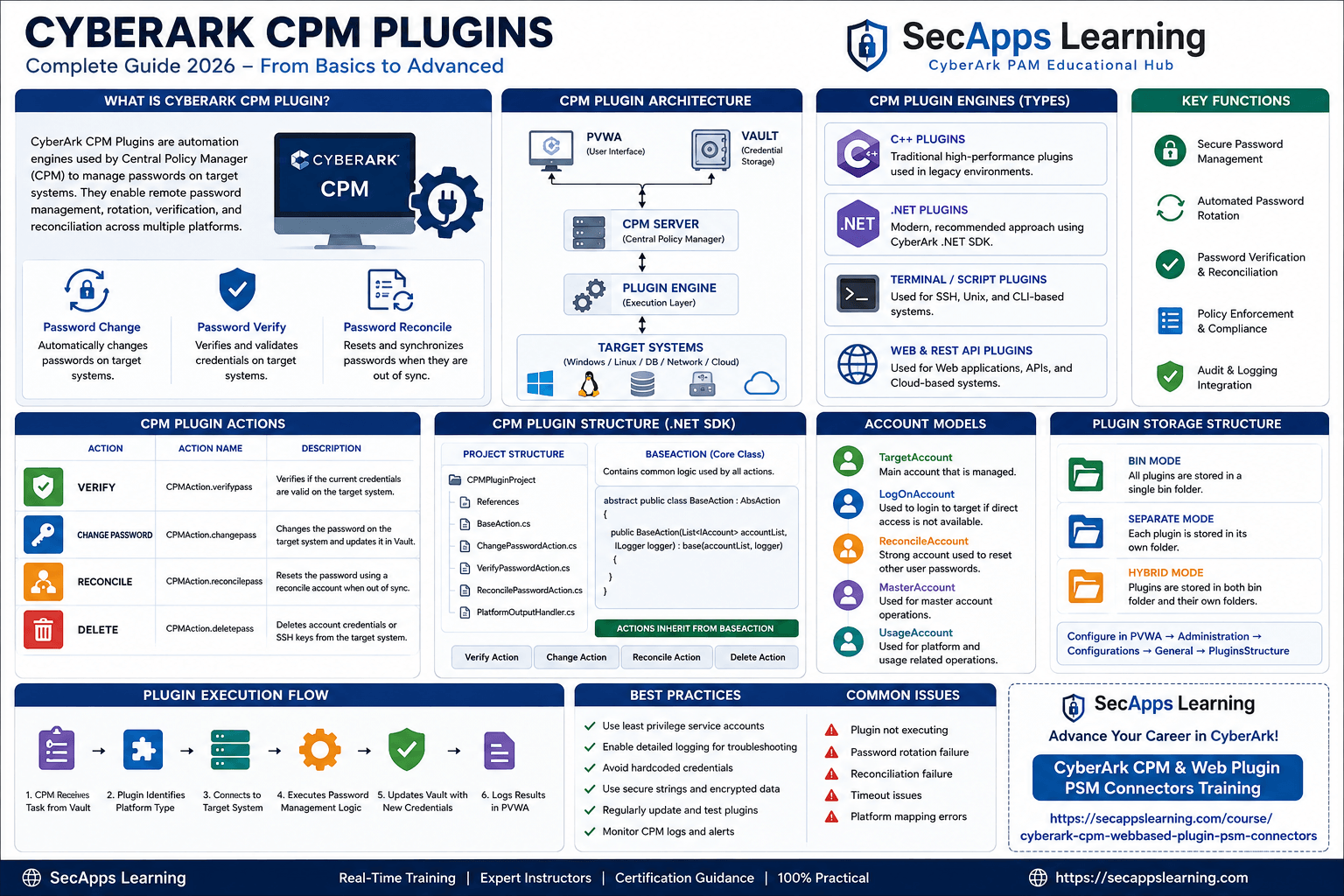
CyberArk CPM plugins are automation scripts or programs used by CyberArk PAM (Privileged Access Management) to manage passwords on target systems.
CPM Plugin = Password Automation Engine + Platform Logic + Vault Integration
They connect:
👉 CyberArk Vault
👉 Target systems (Windows, Linux, DB, Web Apps)
👉 Password policies
CPM plugins perform three major operations:
Automatically changes passwords on target machines.
Ensures password is valid and synchronized.
Resets password when it becomes out-of-sync.
CPM plugins are tightly integrated into CyberArk PAM architecture:
CyberArk Vault (Credential Storage)
CPM Server (Execution Engine)
PVWA (User Interface)
Plugin Engine (Logic Processor)
Target Systems (Servers, DB, APIs)
CPM receives a task from Vault
Plugin identifies platform type
Connects to target system
Executes password logic
Updates Vault with new credentials
Logs results in PVWA
CyberArk supports multiple plugin execution engines:
Traditional high-performance plugins
Used in legacy systems
Modern recommended approach
Built using CyberArk .NET SDK
Used for SSH, Unix, and CLI-based systems.
Used for modern cloud applications and APIs.
CyberArk provides a structured .NET SDK framework for plugin development.
A CPM plugin contains:
BaseAction Class
Action Classes (Change, Verify, Reconcile)
Platform Output Handler
Account Models
BaseAction is the foundation of all CPM plugins.
It contains shared logic such as:
SSH connection handling
API authentication
Logging mechanism
Utility functions
👉 All other actions inherit from this class.
BaseAction
ChangePasswordAction
VerifyPasswordAction
ReconcilePasswordAction
Each CPM plugin supports specific actions defined using CPMAction enum.
Verify = LoginTest(Username, Password) \rightarrow Success / Failure
Used to verify if credentials are valid.
👉 Action Name:
CPMAction.verifypass
✔ Connects to system
✔ Validates credentials
✔ Ensures account accessibility
Used for password rotation.
👉 Action Name:
CPMAction.changepass
Flow:
Logon to system
Change password
Update Vault
Used when password is unknown or out-of-sync.
👉 Action Name:
CPMAction.reconcilepass
✔ Uses reconciliation account
✔ Resets password forcibly
✔ Synchronizes Vault
Used for key or credential removal.
👉 Action Name:
CPMAction.deletepass
Every CPM plugin follows this structure:
public class ChangeAction : BaseAction
{
    public ChangeAction(List accountList, ILogger logger)
        : base(accountList, logger)
    {
    }

    override public CPMAction ActionName
    {
        get { return CPMAction.changepass; }
    }

    override public int run(ref PlatformOutput platformOutput)
    {
        string message = "Password changed successfully";
        int rc = 0;

        // Logic for password change

        platformOutput.Message = message;
        return rc;
    }
}
CPM provides multiple account types:
Main account being managed.
Used for initial login.
Used for password reset scenarios.
High-level control account.
string username = TargetAccount.AccountProp["username"];
CPM plugins can be stored in different formats:
All plugins in a single folder
Each plugin has its own folder
Combination of both
📌 Configuration:
PVWA → Administration → Configurations → PluginsStructure
Automatic password rotation for DB servers
Compliance with RBI regulations
Audit-ready credential management
Router and switch credential management
SSH automation for network devices
API-based credential rotation
SaaS application password control
✔ Cause: Missing platform mapping
✔ Fix: Validate platform assignment
✔ Cause: Network or script issue
✔ Fix: Check CPM logs
✔ Cause: Wrong reconcile account
✔ Fix: Validate account permissions
✔ Cause: Slow target system
✔ Fix: Increase timeout settings
✔ Use least privilege service accounts
✔ Enable detailed CPM logging
✔ Avoid hardcoded credentials
✔ Use encrypted secure strings
✔ Regular plugin updates
| Feature | Manual | CPM Plugin |
|---|---|---|
| Automation | ❌ | ✔ |
| Security | Low | High |
| Audit Trail | Limited | Full |
| Scalability | Poor | Enterprise Grade |
| Compliance | Weak | Strong |
A CPM plugin automates password management on target systems.
C++, .NET, Terminal, REST-based engines.
Resetting a password when it is unknown or out-of-sync.
In bin, separate, or hybrid folder structures.
👉 CyberArk CPM & Web Plugin Training
CyberArk CPM Plugins are the core automation engine of PAM systems.
They enable:
Secure password rotation
Automated reconciliation
Enterprise compliance
Zero manual intervention
If you understand CPM plugins deeply, you understand:
✔ CyberArk architecture
✔ Enterprise security automation
✔ Real-world PAM operations
Your email address will not be published. Required fields are marked*
 August 28 2026
 July 26 2026
 Explained Architecture, Plugins, Connector Management, Hardening and Complete Credential Rotation Guide (2026).png) July 24 2026
July 24 2026
 July 24 2026
.png) July 17 2026
July 17 2026
 July 16 2026
 July 10 2026
 July 09 2026
 July 05 2026
 — Complete Vault, DR, Cluster & Distributed Upgrade Handbook-.png) July 03 2026
July 03 2026
 vs Central Credential Provider (CCP) Complete Guide to Installation, Architecture, Licensing, SDKs, ASCP & Best Practices (2026)-.png) July 01 2026
July 01 2026
.png) June 30 2026
June 30 2026
 June 25 2026
 June 24 2026
.png) June 10 2026
June 10 2026
 June 09 2026
 – Complete Architecture, Deployment, HA, DR & Best Practices Guide 2026.png) June 06 2026
June 06 2026
 Certification Guide 2026 by SL.png) June 04 2026
June 04 2026
 Complete Guide 2026 – Identity Protection, Identity Threat Detection, AI-Powered Security Monitoring, Response Playbooks, and ISI Migration.png) June 02 2026
June 02 2026
 May 30 2026
 Complete Guide – Architecture, Security, User Provisioning & Identity Governance.png) May 29 2026
May 29 2026
 Complete Guide – IdentityIQ, Identity Security Cloud (ISC), Certification, Architecture & Career Roadmap.png) May 27 2026
May 27 2026
 Complete Getting Started Guide – Architecture, Configuration & Real-World Implementation.png) May 26 2026
May 26 2026
 – Complete Comparison 2026.png) May 24 2026
May 24 2026
 May 22 2026
 May 21 2026
 vs Privileged Session Manager (PSM) Complete 2026 Guide.png) May 20 2026
May 20 2026
 May 19 2026
.png) May 18 2026
May 18 2026
.png) May 17 2026
May 17 2026
 The Complete Beginner to Advanced Guide to Ethical Hacking.png) May 15 2026
May 15 2026
 May 15 2026
 May 14 2026
 by SecApps Learning.png) May 14 2026
May 14 2026
 May 13 2026
 (1).png) May 12 2026
May 12 2026
.png) May 11 2026
May 11 2026
 May 10 2026
May 10 2026
May 10 2026
 May 08 2026
.png) May 07 2026
May 07 2026
.png) May 06 2026
May 06 2026
.png) May 06 2026
May 06 2026
 Complete Guide (2026).png) May 05 2026
May 05 2026
.png) May 05 2026
May 05 2026
 (1).png) May 04 2026
May 04 2026
.png) May 03 2026
May 03 2026
.png) May 01 2026
May 01 2026
.png) May 01 2026
May 01 2026
.png) April 30 2026
April 30 2026
.png) April 29 2026
April 29 2026
.png) April 28 2026
April 28 2026
.png) April 27 2026
April 27 2026
 System Health, Safe Management, Platform & Master Policy Explained.png) April 26 2026
April 26 2026
 April 20 2026
.png) April 19 2026
April 19 2026
.png) April 17 2026
April 17 2026
.png) April 16 2026
April 16 2026
.png) April 15 2026
April 15 2026
 April 14 2026
 April 10 2026
 April 09 2026
 April 08 2026
 April 07 2026
 July 31 2025
 May 01 2026
 December 26 2024
 December 15 2024
.jpeg) December 08 2024
December 08 2024
 May 01 2026
 October 29 2024
 October 19 2024
 October 15 2024
 October 07 2024
 September 30 2024
 September 23 2024
 September 16 2024
 May 04 2026
 August 27 2024
 August 27 2024
 August 21 2024
 August 19 2024
 May 01 2026
 May 10 2024
 May 08 2024
 May 01 2026
 April 30 2024
.jpg) April 29 2024
April 29 2024
 April 25 2024
 April 22 2024
 April 12 2024
 April 05 2024
 March 30 2024
 May 01 2026
 March 27 2024
 March 27 2024
 March 11 2024
 March 07 2024
 February 29 2024
.jpg) May 01 2026
May 01 2026
 January 24 2024
 January 20 2024
 January 20 2024
 January 20 2024
 January 20 2024
 January 03 2024
 January 03 2024
 January 03 2024
 January 03 2024
Copyright 2022 SecApps Learning. All Right Reserved

Comments ()