.png)
🔥 Introduction: Why CyberArk Vault is the Heart of PAM
In any enterprise Privileged Access Management (PAM) implementation, the CyberArk Vault is the most critical and secure component. It is not just another server — it is the core security engine that protects all privileged credentials, secrets, and sensitive configuration data.
Every CyberArk component such as PVWA, CPM, PSM, and PSM-SSH depends on the Vault for authentication, credential retrieval, and secure storage.
👉 Without Vault, CyberArk simply cannot function.
Think of CyberArk Vault as the “Bank Locker System of Enterprise IT Security”, where every privileged credential is stored with military-grade encryption and strict access control.
The CyberArk Vault is a highly secured, encrypted digital repository used to store:
Privileged user passwords
Application credentials
SSH keys and certificates
API secrets
Service account credentials
Unlike traditional password managers, the Vault is:
✔ Completely isolated from the internet
✔ Protected by multiple encryption layers
✔ Accessible only via CyberArk components
✔ Designed with zero-trust architecture
👉 In simple terms, it is the secure brain of the CyberArk ecosystem.
The Vault architecture is designed with maximum security, redundancy, and fault tolerance.
Stores all secrets and encrypted data
Handles authentication requests
Acts as the main production Vault
Passive replica of Primary Vault
Used during failover scenarios
Continuously synchronized with Primary Vault
Core service running the Vault
Handles encryption/decryption logic
Manages Safe-level security policies
Secure communication channel between Primary and DR Vault
Ensures real-time or scheduled sync
PVWA → Sends request → Vault
CPM → Fetches password → Vault
PSM → Requests session credentials → Vault
Vault → Validates → Returns encrypted credentials
Let’s understand a real enterprise flow:
A user logs into the CyberArk PVWA portal.
PVWA sends authentication request to Vault.
Vault checks:
User identity
Safe permissions
MFA policies
Vault retrieves encrypted password from Safe.
Password is decrypted in-memory and passed securely.
PSM uses credentials to initiate secure session.
Installing CyberArk Vault is a highly controlled enterprise process.
Hardened Windows Server
Static IP configuration
Isolated network segment
Proper DNS configuration
Time synchronization (NTP)
OS hardening as per CyberArk standards
Vault software installation
Safe creation for system accounts
License configuration
PrivateArk service initialization
Initial admin setup
👉 For complete enterprise installation workflows, you can refer to:CyberArk Blogs Hub & Implementation
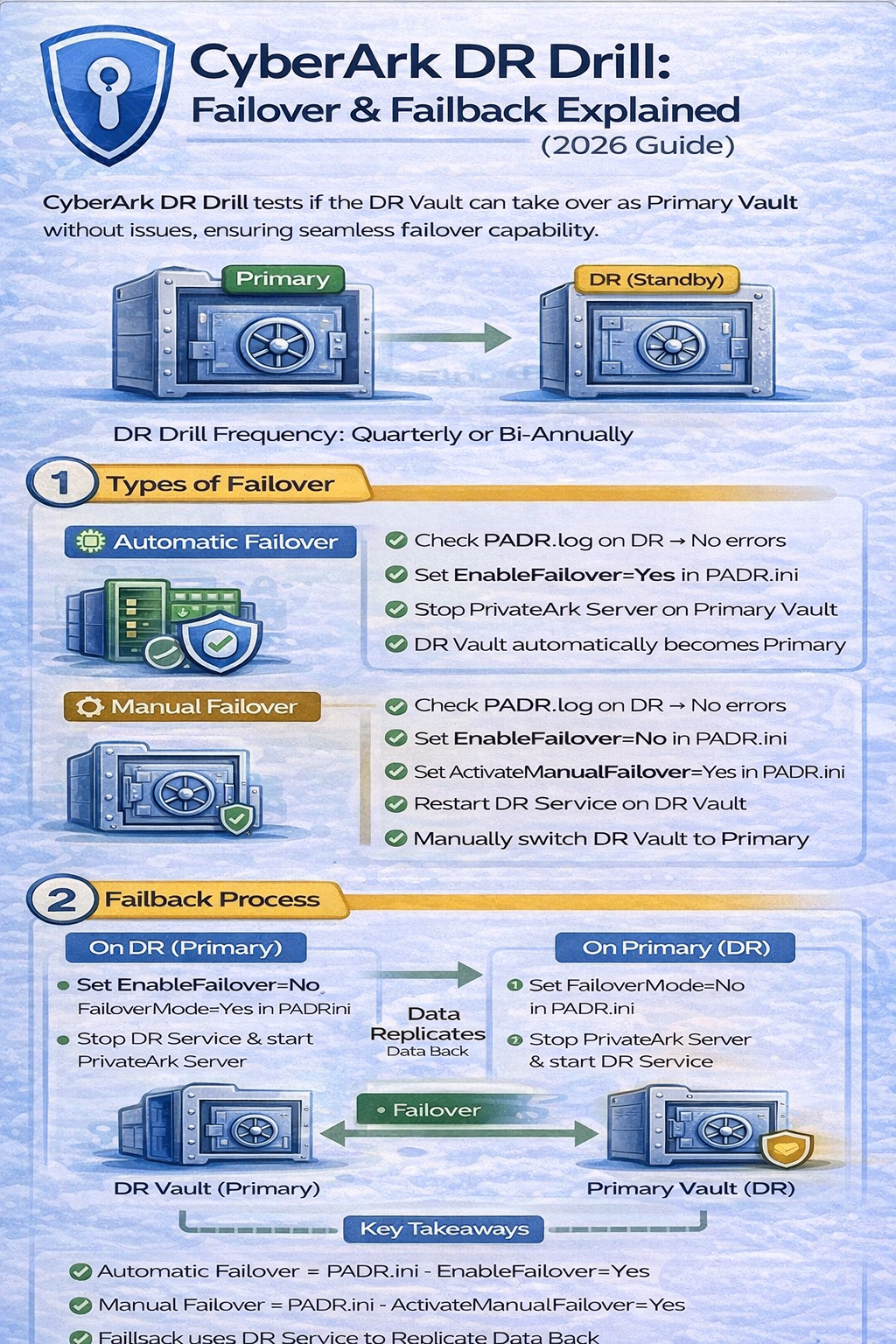
Enterprise environments always require 24/7 availability, so CyberArk provides DR Vault architecture.
Active system
Handles all production traffic
Passive system
Syncs data from Primary Vault
If Primary Vault fails:
DR Vault is activated manually or automatically
PVWA and CPM reconnect to DR Vault
Operations continue with minimal downtime
Vault failover is a controlled security operation, not an automatic load balancing system.
Backup and restore is one of the most critical operations in Vault management.
Full Backup
Incremental Backup
Configuration Backup
Install New Vault and Restore the data from backup Server on the New Vault.
Restore encrypted backup files
Validate integrity
Restart Vault services
Restoring mismatched versions
Incorrect DR synchronization
Missing encryption keys
👉 For detailed troubleshooting scenarios, refer:
CyberArk Troubleshooting Guide
In real-time enterprise environments, Vault issues can cause major operational impact.
Causes:
Network failure
Service down
Firewall block
Causes:
Incorrect credentials
Safe permission issue
Vault service stopped
Causes:
DR connectivity issue
Certificate mismatch
Network latency
Causes:
Improper shutdown
Storage issues
Backup mismatch
Expired certificates
Wrong CA configuration
CyberArk Vault is built on zero-trust and multi-layer security principles.
AES-256 Encryption at Rest
TLS Encryption in Transit
Dual Control Mechanism
MFA Authentication
Role-Based Access Control (RBAC)
Each Safe has:
Owners
Members
Permissions (Read, Write, Use, Admin)
Secure ATM admin credentials
Database access protection
Network device credentials
Router/switch privileged access
AWS IAM secrets
Azure service principals
✔ Always maintain DR Vault sync
✔ Regular backup validation
✔ Patch Vault during maintenance windows
✔ Restrict Vault admin access
✔ Monitor replication logs daily
If you want to become a Senior CyberArk Engineer, Vault knowledge is mandatory.
Interviewers often ask:
How Vault architecture works
DR failover mechanism
Backup restore process
Safe permissions model
Vault troubleshooting scenarios
👉 Mastering Vault = 70% of CyberArk job expertise
To build strong CyberArk expertise, follow these cluster articles:
CyberArk Vault is not just a component — it is the foundation of enterprise PAM security.
Without Vault:
No password management
No session control
No privileged security
With Vault:
Complete enterprise-grade protection
Secure automation
Centralized privileged control
If you want to become job-ready in CyberArk and master real enterprise implementations, join our training:
Your email address will not be published. Required fields are marked*
 August 28 2026
 July 26 2026
 Explained Architecture, Plugins, Connector Management, Hardening and Complete Credential Rotation Guide (2026).png) July 24 2026
July 24 2026
 July 24 2026
.png) July 17 2026
July 17 2026
 July 16 2026
 July 10 2026
 July 09 2026
 July 05 2026
 — Complete Vault, DR, Cluster & Distributed Upgrade Handbook-.png) July 03 2026
July 03 2026
 vs Central Credential Provider (CCP) Complete Guide to Installation, Architecture, Licensing, SDKs, ASCP & Best Practices (2026)-.png) July 01 2026
July 01 2026
.png) June 30 2026
June 30 2026
 June 25 2026
 June 24 2026
.png) June 10 2026
June 10 2026
 June 09 2026
 – Complete Architecture, Deployment, HA, DR & Best Practices Guide 2026.png) June 06 2026
June 06 2026
 Certification Guide 2026 by SL.png) June 04 2026
June 04 2026
 Complete Guide 2026 – Identity Protection, Identity Threat Detection, AI-Powered Security Monitoring, Response Playbooks, and ISI Migration.png) June 02 2026
June 02 2026
 May 30 2026
 Complete Guide – Architecture, Security, User Provisioning & Identity Governance.png) May 29 2026
May 29 2026
 Complete Guide – IdentityIQ, Identity Security Cloud (ISC), Certification, Architecture & Career Roadmap.png) May 27 2026
May 27 2026
 Complete Getting Started Guide – Architecture, Configuration & Real-World Implementation.png) May 26 2026
May 26 2026
 – Complete Comparison 2026.png) May 24 2026
May 24 2026
 May 22 2026
 May 21 2026
 vs Privileged Session Manager (PSM) Complete 2026 Guide.png) May 20 2026
May 20 2026
 May 19 2026
.png) May 18 2026
May 18 2026
.png) May 17 2026
May 17 2026
 The Complete Beginner to Advanced Guide to Ethical Hacking.png) May 15 2026
May 15 2026
 May 15 2026
 May 14 2026
 by SecApps Learning.png) May 14 2026
May 14 2026
 May 13 2026
 (1).png) May 12 2026
May 11 2026
May 12 2026
May 11 2026
 May 10 2026
 May 10 2026
 May 08 2026
.png) May 07 2026
May 07 2026
.png) May 06 2026
May 06 2026
.png) May 06 2026
May 06 2026
 Complete Guide (2026).png) May 05 2026
May 05 2026
.png) May 05 2026
May 05 2026
 (1).png) May 04 2026
May 04 2026
.png) May 03 2026
May 03 2026
.png) May 01 2026
May 01 2026
.png) May 01 2026
May 01 2026
.png) April 30 2026
April 30 2026
.png) April 29 2026
April 29 2026
.png) April 28 2026
April 28 2026
.png) April 27 2026
April 27 2026
 System Health, Safe Management, Platform & Master Policy Explained.png) April 26 2026
April 26 2026
 April 20 2026
.png) April 19 2026
April 19 2026
.png) April 17 2026
April 17 2026
.png) April 16 2026
April 16 2026
.png) April 15 2026
April 15 2026
 April 14 2026
 April 10 2026
 April 09 2026
 April 08 2026
 April 07 2026
 July 31 2025
 May 01 2026
 December 26 2024
 December 15 2024
.jpeg) December 08 2024
December 08 2024
 May 01 2026
 October 29 2024
 October 19 2024
 October 15 2024
 October 07 2024
 September 30 2024
 September 23 2024
 September 16 2024
 May 04 2026
 August 27 2024
 August 27 2024
 August 21 2024
 August 19 2024
 May 01 2026
 May 10 2024
 May 08 2024
 May 01 2026
 April 30 2024
.jpg) April 29 2024
April 29 2024
 April 25 2024
 April 22 2024
 April 12 2024
 April 05 2024
 March 30 2024
 May 01 2026
 March 27 2024
 March 27 2024
 March 11 2024
 March 07 2024
 February 29 2024
.jpg) May 01 2026
May 01 2026
 January 24 2024
 January 20 2024
 January 20 2024
 January 20 2024
 January 20 2024
 January 03 2024
 January 03 2024
 January 03 2024
 January 03 2024
Copyright 2022 SecApps Learning. All Right Reserved

Comments ()