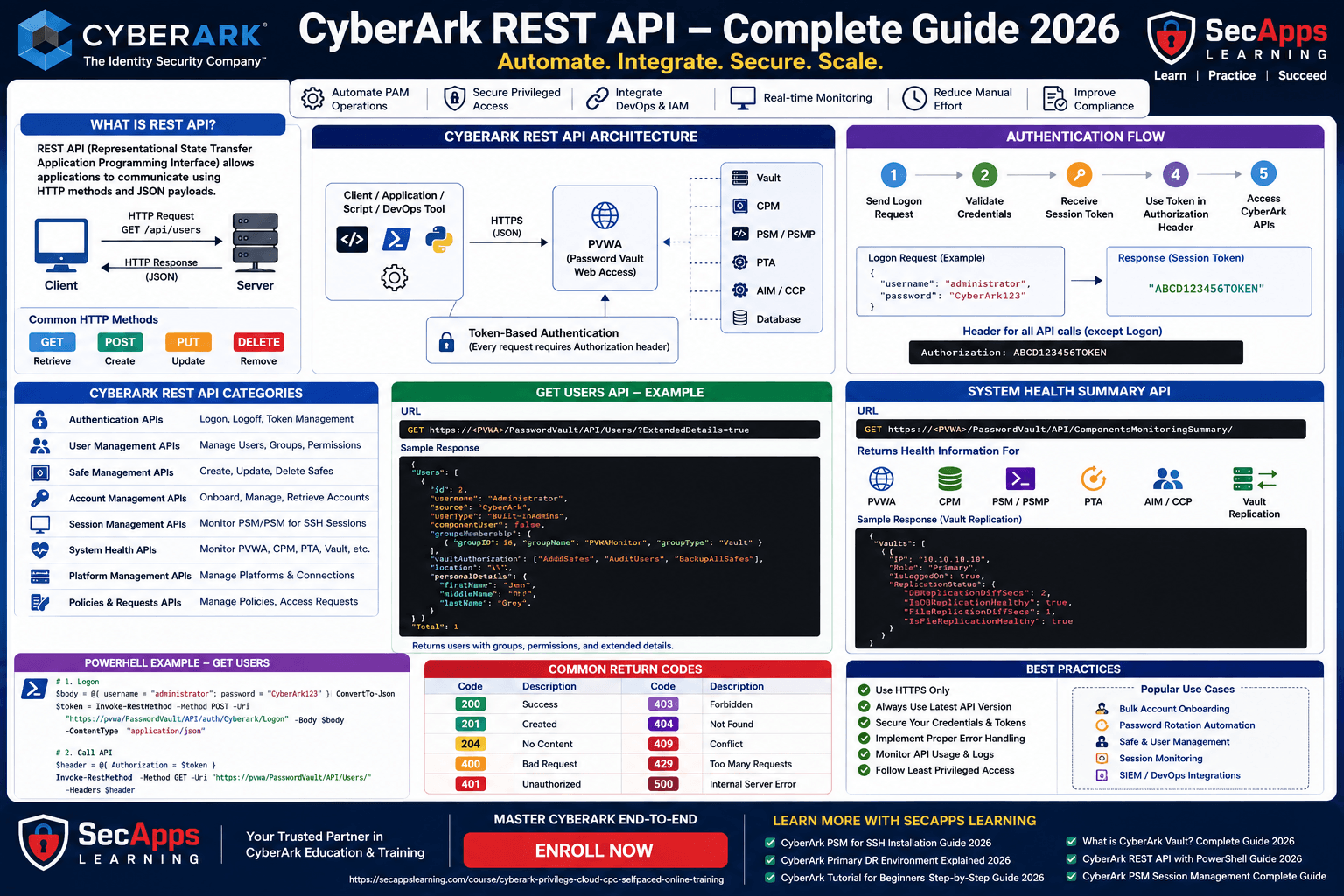
Modern cybersecurity operations require automation, scalability, and rapid integration between multiple systems. Organizations managing thousands of privileged accounts cannot rely only on manual administration through graphical interfaces. This is where REST APIs become extremely important.
CyberArk PAM - Self-Hosted provides a powerful set of REST APIs that enable organizations to automate:
User management
Safe management
Account onboarding
Password retrieval
Session monitoring
System health checks
Platform management
Authentication workflows
Privileged access automation
CyberArk REST APIs are now widely used in:
DevOps
IAM automation
PAM orchestration
CI/CD integrations
Service account onboarding
Compliance automation
Cloud security workflows
In this detailed guide, we will first understand what REST APIs are, how they work, and then deeply explore CyberArk REST APIs with examples, architecture, authentication methods, PowerShell integrations, best practices, troubleshooting, and automation use cases.
REST API stands for:
Representational State Transfer Application Programming Interface
A REST API allows one application to communicate securely with another application using:
HTTP methods
JSON payloads
HTTPS communication
REST APIs are commonly used for:
Web applications
Cloud platforms
Mobile applications
Infrastructure automation
Security tools
Imagine a food delivery application.
When you open the app and request restaurant information:
Your mobile app sends a request to the backend server.
The server processes the request.
The server returns data in JSON format.
That communication happens through APIs.
GET Request
GET https://example.com/api/users
This retrieves users.
POST Request
POST https://example.com/api/users
This creates a new user.
| Method | Purpose |
|---|---|
| GET | Retrieve data |
| POST | Create data |
| PUT | Update existing data |
| DELETE | Remove data |
Most REST APIs use JSON.
Example:
{
  "username": "administrator",
  "role": "Vault Admin"
}
JSON is lightweight and easy for applications to understand.
In cybersecurity environments, APIs help automate repetitive operations.
Instead of manually:
Creating users
Onboarding accounts
Rotating passwords
Monitoring sessions
You can automate everything using scripts.
This is especially useful in:
PAM
IAM
DevSecOps
Cloud security
SIEM integrations
CyberArk REST API enables administrators and developers to interact directly with CyberArk components programmatically.
CyberArk REST APIs are part of the PVWA installation and are available immediately after deployment.
These APIs allow automation of:
Safes
Users
Platforms
Accounts
Session management
Monitoring
PTA operations
CPM integrations
Vault activities
CyberArk REST APIs are exposed through:
PVWA (Password Vault Web Access)
The API endpoint typically looks like:
https:///PasswordVault/API/
All requests go through PVWA.
The APIs communicate with:
Vault
PVWA
CPM
PSM
PTA
PSMP
AIM
CCP
Organizations use CyberArk APIs for:
1. Automation
Automatically onboard accounts from servers.
2. DevOps Integration
Integrate CyberArk with:
Jenkins
Ansible
Terraform
Kubernetes
Azure DevOps
3. Bulk Operations
Manage thousands of accounts programmatically.
4. Compliance
Generate automated audit reports.
5. Session Monitoring
Track PSM sessions dynamically.
Before using any CyberArk API:
You must authenticate first.
CyberArk APIs use token-based authentication.
Step 1 – Logon API
Example URL:
https:///PasswordVault/API/auth/Cyberark/Logon
Step 2 – Receive Session Token
CyberArk returns a session token.
Example:
"ABCD123456TOKEN"
Step 3 – Use Token in Authorization Header
Authorization: ABCD123456TOKEN
This token is required for all API calls except logon.
CyberArk supports:
| Authentication Type | Description |
|---|---|
| CyberArk | Native authentication |
| LDAP | Active Directory integration |
| Windows | Windows authentication |
| RADIUS | MFA integration |
Request
{
  "username":"administrator",
  "password":"CyberArk123"
}
PowerShell Example
$Body = @{
    username = "administrator"
    password = "CyberArk123"
} | ConvertTo-Json

$token = Invoke-RestMethod `
-Method POST `
-Uri "https://pvwa/PasswordVault/API/auth/Cyberark/Logon" `
-Body $Body `
-ContentType "application/json"
The session token:
Identifies authenticated users
Usually valid for 20 minutes
Must be passed in headers
Example:
$Header = @{
   Authorization = $token
}
CyberArk APIs are organized into categories.
1. Authentication APIs
Used for:
Logon
Logoff
Token management
2. User Management APIs
Manage:
Vault users
LDAP users
User groups
Permissions
3. Safe APIs
Manage:
Safes
Safe members
Permissions
4. Account APIs
Manage:
Privileged accounts
Password retrieval
Account onboarding
5. Session Management APIs
Monitor:
PSM sessions
Active sessions
Recordings
6. System Health APIs
Monitor CyberArk infrastructure.
One of the most useful APIs is:
ComponentsMonitoringSummary
This API provides health information for:
Vault
PVWA
CPM
PSM
PTA
AIM
Example API URL
https:///PasswordVault/API/ComponentsMonitoringSummary/
For Components
Component status
Connected users
Active sessions
Managed accounts
For Vault Replication
DR replication health
File replication status
Database replication delay
Organizations use this API to:
Build monitoring dashboards
Integrate with SIEM
Monitor DR health
Trigger alerts automatically
Understanding Return Codes
CyberArk APIs return HTTP status codes.
Common Return Codes
| Code | Meaning |
|---|---|
| 200 | Success |
| 201 | Resource created |
| 204 | No content |
| 400 | Bad request |
| 401 | Unauthorized |
| 403 | Forbidden |
| 404 | Not found |
| 409 | Conflict |
| 429 | Too many requests |
| 500 | Internal server error |
One of the most commonly used APIs.
URL
https:///PasswordVault/API/Users/
Returns:
Vault users
LDAP users
Groups
Permissions
User details
{
  "username": "Administrator",
  "source": "CyberArk",
  "userType": "Built-InAdmins"
}
You can filter users by:
Username
User type
Component users
Example:
?filter=userType eq LDAP
When enabled:
ExtendedDetails=true
Additional information is returned:
User DN
Group membership
Organization
Department
PowerShell is the most popular language for CyberArk automation.
Reasons:
Native Windows support
Easy JSON handling
Strong automation capability
Example – Get Users
Invoke-RestMethod `
-Uri "https://pvwa/PasswordVault/API/Users/" `
-Headers $Header `
-Method GET
Example – Create Safe
$Body = @{

   SafeName = "Linux-Servers"

   Description = "Production Linux Accounts"

} | ConvertTo-Json
Example – Onboard Account
$Body = @{
   name = "root"
   address = "linux01"
   userName = "root"
}
1. Use HTTPS Only
CyberArk APIs should always use TLS encryption.
2. Avoid Hardcoded Passwords
Store secrets securely.
3. Use Session Timeout Properly
Log off inactive sessions.
4. Use Latest API Version
Newer APIs provide:
Better performance
More capabilities
Better security
5. Handle Errors Properly
Always check return codes.
CyberArk follows REST standards.
Important:
A PUT request replaces the entire object.
If fields are omitted:
Missing parameters may become NULL
Boolean fields revert to default values
CyberArk supports Swagger documentation.
Swagger URL:
/PasswordVault/swagger/docs/v1
Benefits:
Interactive API testing
API documentation
Request examples
Issue: 405 Method Not Allowed
Cause:
WebDAV installed on IIS.
Solution
Remove WebDAV.
Cause:
Incorrect HTTPS binding in web.config.
Solution
Add:
bindingConfiguration="httpsBinding"
1. Bulk Account Onboarding
Automatically onboard:
Windows accounts
Linux accounts
Database accounts
2. Password Rotation Automation
Trigger CPM operations programmatically.
3. Safe Creation Automation
Create project safes dynamically.
4. Session Monitoring
Track active privileged sessions.
5. SIEM Integration
Send audit logs to:
Splunk
QRadar
Sentinel
CyberArk APIs are heavily used in DevOps.
Examples:
Kubernetes secret retrieval
Terraform integrations
Jenkins password retrieval
CI/CD authentication
Older CyberArk automation used PACLI.
Modern environments use REST APIs because they are:
Faster
Easier
Cloud-friendly
Language independent
Use MFA
Use RADIUS or SAML integrations.
Restrict API Users
Grant minimum permissions.
Rotate Tokens
Avoid long-running sessions.
Monitor API Usage
Track API logs regularly.
Deepen your CyberArk expertise with these detailed guides:
CyberArk REST APIs are one of the most powerful capabilities within the CyberArk ecosystem.
They enable organizations to:
Automate PAM operations
Improve scalability
Reduce manual effort
Strengthen compliance
Integrate security into DevOps pipelines
As organizations move toward:
Cloud
Zero Trust
Infrastructure automation
DevSecOps
CyberArk REST APIs become essential for modern PAM operations.
Whether you are a:
CyberArk Administrator
Security Engineer
DevOps Engineer
PAM Consultant
IAM Architect
Learning CyberArk REST APIs is now a critical skill in 2026 and beyond.
Want to master:
✅ CyberArk REST APIs
✅ PowerShell automation
✅ CPM & PSM integrations
✅ Vault architecture
✅ Privilege Cloud
✅ Real-time implementation projects
👉 Enroll now:
CyberArk Privilege Cloud (CPC) Self-Paced Online Training
Your email address will not be published. Required fields are marked*
 August 28 2026
 July 26 2026
 Explained Architecture, Plugins, Connector Management, Hardening and Complete Credential Rotation Guide (2026).png) July 24 2026
July 24 2026
 July 24 2026
.png) July 17 2026
July 17 2026
 July 16 2026
 July 10 2026
 July 09 2026
 July 05 2026
 — Complete Vault, DR, Cluster & Distributed Upgrade Handbook-.png) July 03 2026
July 03 2026
 vs Central Credential Provider (CCP) Complete Guide to Installation, Architecture, Licensing, SDKs, ASCP & Best Practices (2026)-.png) July 01 2026
July 01 2026
.png) June 30 2026
June 30 2026
 June 25 2026
 June 24 2026
.png) June 10 2026
June 10 2026
 June 09 2026
 – Complete Architecture, Deployment, HA, DR & Best Practices Guide 2026.png) June 06 2026
June 06 2026
 Certification Guide 2026 by SL.png) June 04 2026
June 04 2026
 Complete Guide 2026 – Identity Protection, Identity Threat Detection, AI-Powered Security Monitoring, Response Playbooks, and ISI Migration.png) June 02 2026
June 02 2026
 May 30 2026
 Complete Guide – Architecture, Security, User Provisioning & Identity Governance.png) May 29 2026
May 29 2026
 Complete Guide – IdentityIQ, Identity Security Cloud (ISC), Certification, Architecture & Career Roadmap.png) May 27 2026
May 27 2026
 Complete Getting Started Guide – Architecture, Configuration & Real-World Implementation.png) May 26 2026
May 26 2026
 – Complete Comparison 2026.png) May 24 2026
May 24 2026
 May 22 2026
May 21 2026
May 22 2026
May 21 2026
 vs Privileged Session Manager (PSM) Complete 2026 Guide.png) May 20 2026
May 20 2026
 May 19 2026
.png) May 18 2026
May 18 2026
.png) May 17 2026
May 17 2026
 The Complete Beginner to Advanced Guide to Ethical Hacking.png) May 15 2026
May 15 2026
 May 15 2026
 May 14 2026
 by SecApps Learning.png) May 14 2026
May 14 2026
 May 13 2026
 (1).png) May 12 2026
May 12 2026
.png) May 11 2026
May 11 2026
 May 10 2026
 May 10 2026
 May 08 2026
.png) May 07 2026
May 07 2026
.png) May 06 2026
May 06 2026
.png) May 06 2026
May 06 2026
 Complete Guide (2026).png) May 05 2026
May 05 2026
.png) May 05 2026
May 05 2026
 (1).png) May 04 2026
May 04 2026
.png) May 03 2026
May 03 2026
.png) May 01 2026
May 01 2026
.png) May 01 2026
May 01 2026
.png) April 30 2026
April 30 2026
.png) April 29 2026
April 29 2026
.png) April 28 2026
April 28 2026
.png) April 27 2026
April 27 2026
 System Health, Safe Management, Platform & Master Policy Explained.png) April 26 2026
April 26 2026
 April 20 2026
.png) April 19 2026
April 19 2026
.png) April 17 2026
April 17 2026
.png) April 16 2026
April 16 2026
.png) April 15 2026
April 15 2026
 April 14 2026
 April 10 2026
 April 09 2026
 April 08 2026
 April 07 2026
 July 31 2025
 May 01 2026
 December 26 2024
 December 15 2024
.jpeg) December 08 2024
December 08 2024
 May 01 2026
 October 29 2024
 October 19 2024
 October 15 2024
 October 07 2024
 September 30 2024
 September 23 2024
 September 16 2024
 May 04 2026
 August 27 2024
 August 27 2024
 August 21 2024
 August 19 2024
 May 01 2026
 May 10 2024
 May 08 2024
 May 01 2026
 April 30 2024
.jpg) April 29 2024
April 29 2024
 April 25 2024
 April 22 2024
 April 12 2024
 April 05 2024
 March 30 2024
 May 01 2026
 March 27 2024
 March 27 2024
 March 11 2024
 March 07 2024
 February 29 2024
.jpg) May 01 2026
May 01 2026
 January 24 2024
 January 20 2024
 January 20 2024
 January 20 2024
 January 20 2024
 January 03 2024
 January 03 2024
 January 03 2024
 January 03 2024
Copyright 2022 SecApps Learning. All Right Reserved

Comments ()