.png)
Preparing for a CyberArk interview today is very different from a few years ago.
Companies are no longer asking only:
❌ “What is Vault?”
❌ “What is CPM?”
Now interviews focus on:
✔ Real-world troubleshooting
✔ Architecture decisions
✔ Production scenarios
✔ HA & DR
✔ CPM plugin understanding
✔ PSM connection flows
✔ Password management logic
This guide covers advanced CyberArk interview questions with detailed explanations and real-world examples — exactly the kind of questions asked in L2/L3, implementation, and senior engineer interviews.
If you're new to CyberArk, start here first:
👉 What is CyberArk? Complete Beginner Guide
👉 Understand PAM fundamentals:
What is Privileged Access Management (PAM)?
👉 Learn architecture:
CyberArk Architecture Explained
This is one of the most asked real-time interview questions.
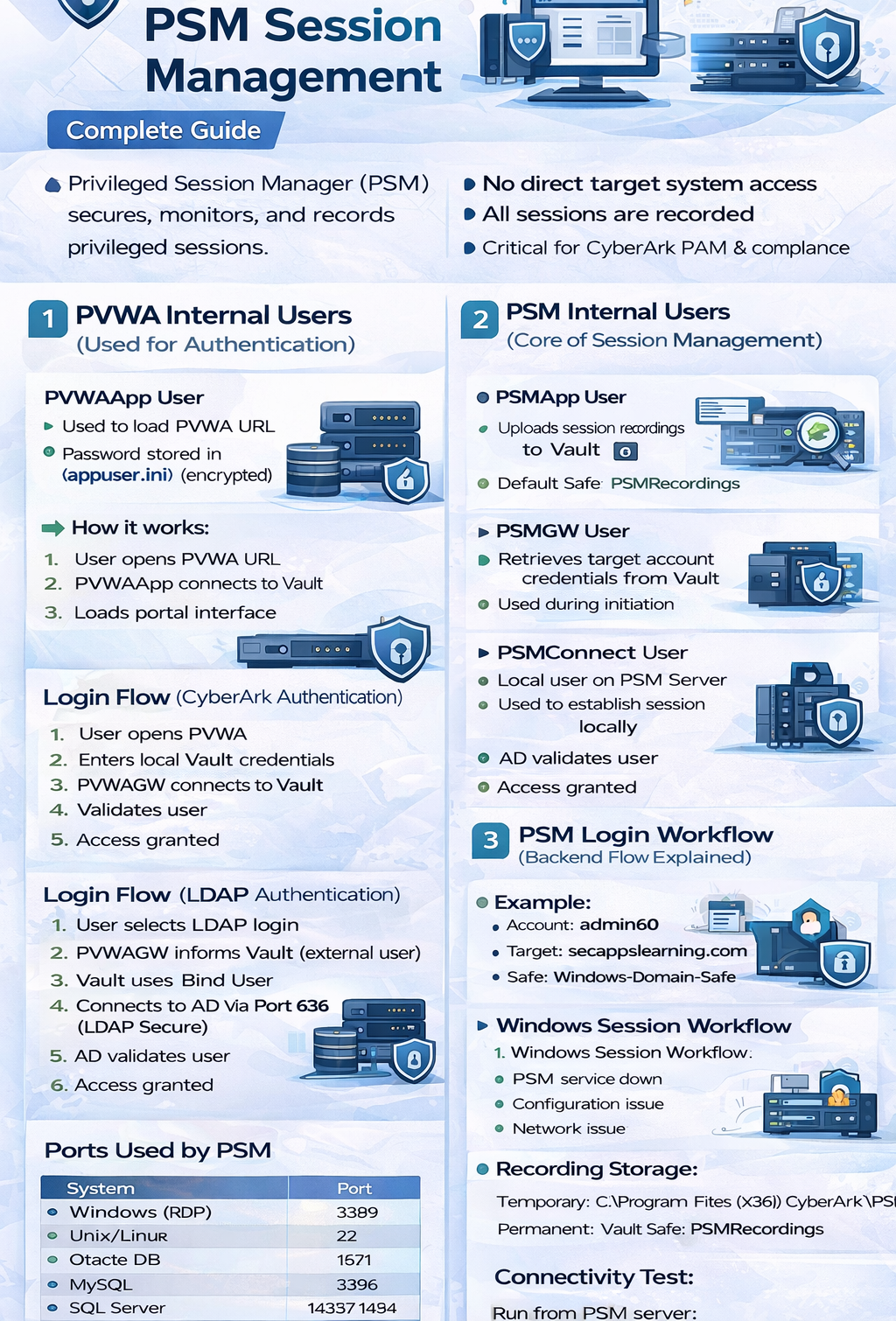
When a user launches a privileged session:
The user logs into PVWA using:
LDAP
SAML
RADIUS
CyberArk authentication
The user selects the target account from the Safe.
CyberArk checks:
Safe permissions
Dual control approvals
Access policy
PVWA redirects the session to the PSM server.
PSM acts as a secure proxy or jump server.
👉 Important:
The actual password is never exposed to the user.
PSM retrieves credentials securely from the Vault.
PSM initiates:
RDP
SSH
SQL
Web session
to the target server.
The session is recorded:
Video
Keystrokes
Commands
for compliance and auditing.
Once the session ends:
Logs are stored
Audit trail generated
Session archived
Suppose a Domain Administrator accesses a production Windows server.
Without PSM:
❌ Password exposed
❌ No monitoring
With PSM:
✔ Password hidden
✔ Session recorded
✔ Full audit trail available
👉 Learn detailed PSM concepts:CyberArk PSM Complete Guide
This is one of the most common scenario-based questions.
Review:
PMError.log
PMTrace.log
Look for:
Authentication failures
Network timeout
Access denied
Check:
Firewall
Port connectivity
DNS resolution
Example:
If CPM cannot connect to target server:
❌ Password change fails
Check:
Password policy
Reconcile account
Allowed characters
Example:
If the target Windows account lacks “Change Password” rights:
❌ CPM fails
Many interviewers ask this.
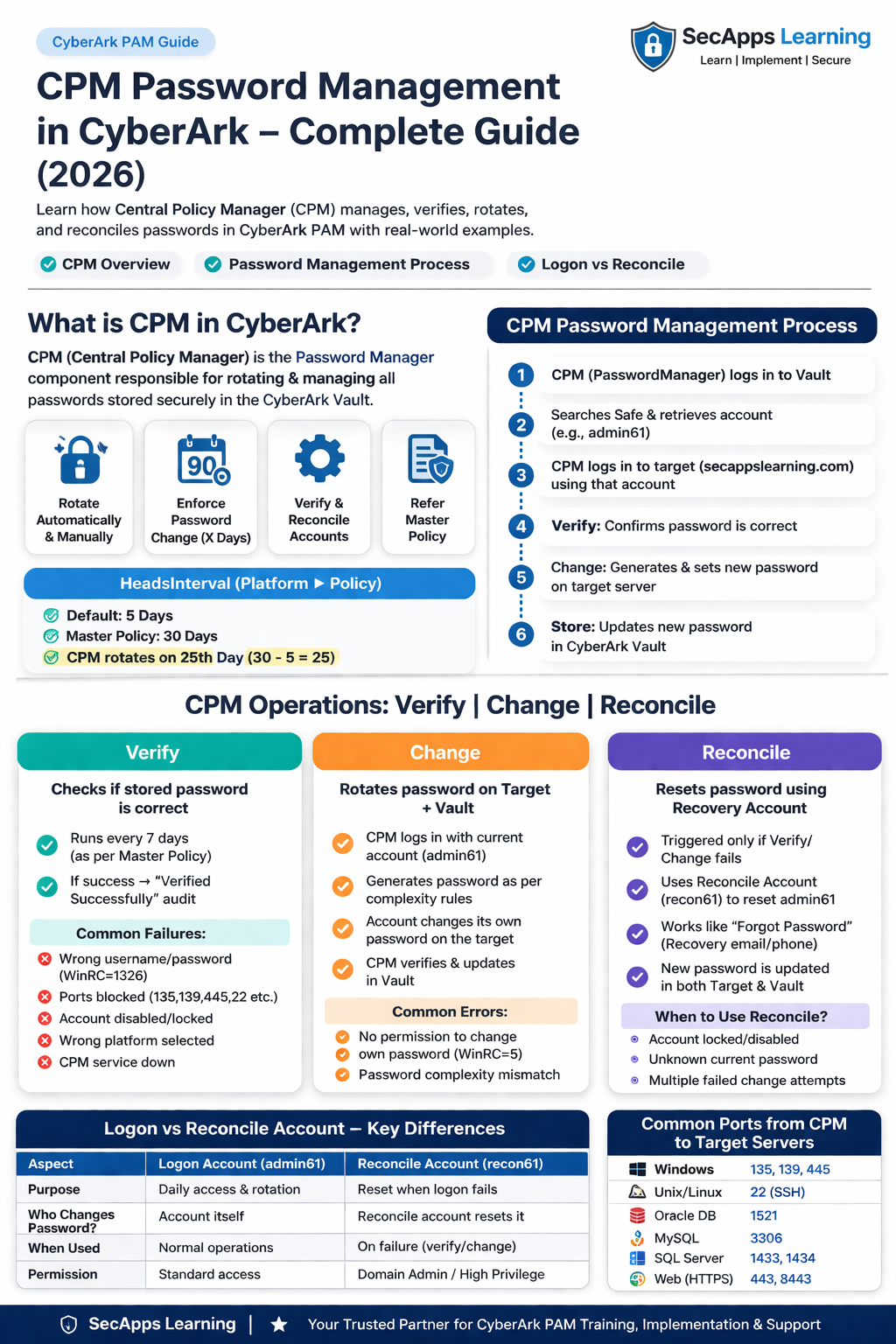
If password is out of sync:
CPM uses reconcile account
Resets target password
If reconcile account permissions are wrong:
❌ Reconcile fails
A Linux root account password rotation fails.
Investigation showed:
SSH access working
CPM reachable
Reconcile account expired
👉 Root cause:
Expired reconcile account password.
👉 Learn detailed CPM concepts:CyberArk CPM Guide
This question looks simple — but interviewers expect real-time understanding.
CyberArk logs into target system using stored password to confirm password validity.
Vault password = Actual server password
✔ Verify successful
CyberArk changes the password on target system and updates Vault.
Password rotated every 30 days.
Used when password in Vault is incorrect.
CyberArk uses reconcile account to reset password.
An administrator manually changed password on server.
Now:
❌ Vault password incorrect
❌ Verify fails
Solution:
✔ Reconcile resets password
✔ Vault updated
Very important for implementation interviews.
Vault hardening means securing the Digital Vault using strict security controls.
CyberArk Vault is designed as:
Isolated system
Minimal services
Restricted communication
Dedicated server
Limited ports
No internet access
No third-party software
OS hardening
Vault contains:
Production passwords
Root credentials
SSH keys
Secrets
If Vault compromised:
🚨 Entire organization at risk
👉 Learn Vault deeply:CyberArk Vault Complete Guide
This is commonly asked in implementation and operations interviews.
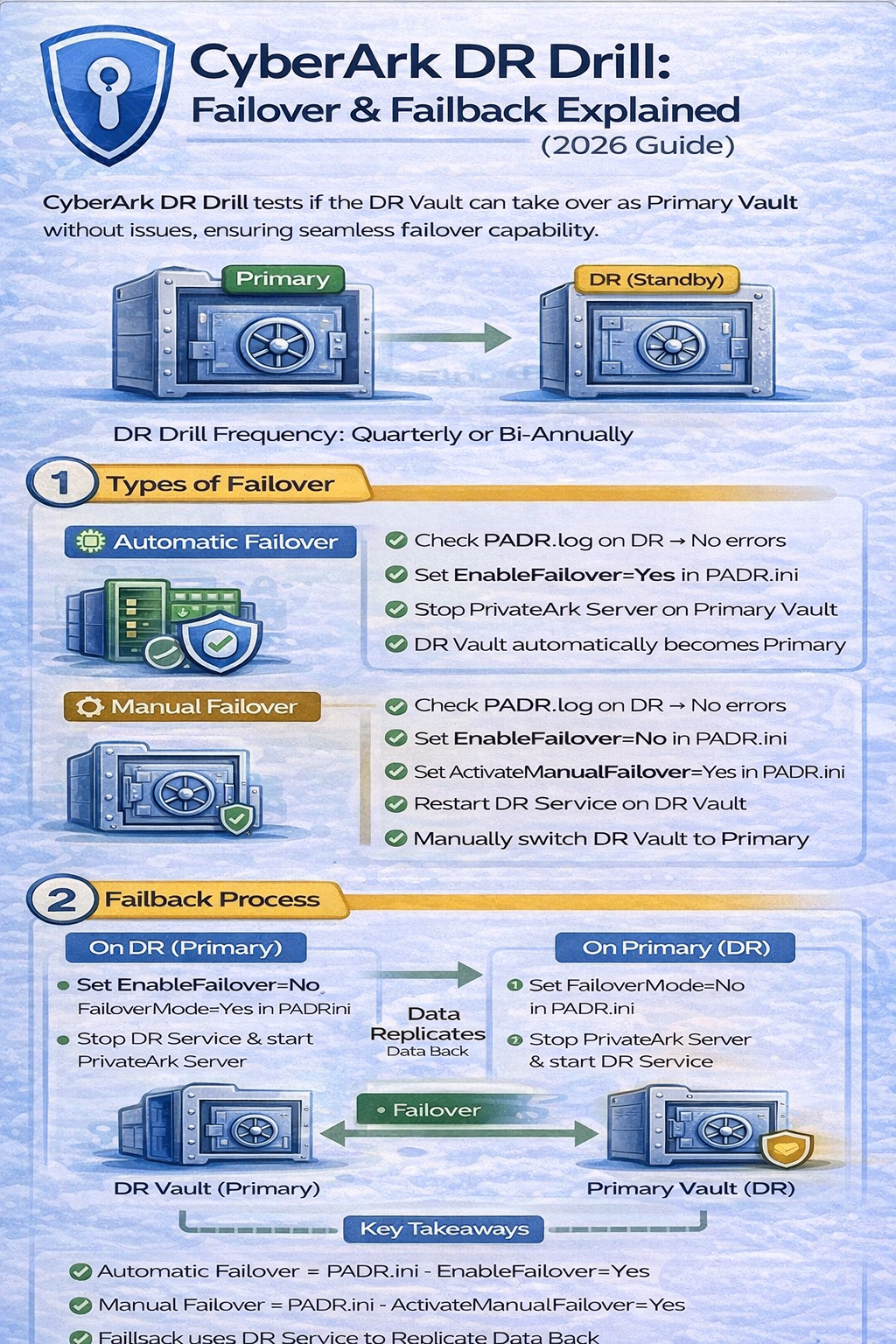
CyberArk DR Vault continuously replicates data from Primary Vault.
DR Vault:
Detects failure
Stops DR service
Promotes itself as Primary
Suppose production Vault server crashes.
DR Vault becomes active:
✔ Business continuity maintained
✔ Users continue accessing accounts
Once original Vault restored:
Synchronization occurs
Primary role restored
This is a famous interview question. (secappslearning.com)
Each Safe is assigned to a specific CPM.
If multiple CPMs manage same Safe simultaneously:
❌ Password conflicts
❌ Synchronization issues
CPM-1 changes password.
At same time CPM-2 tries verification.
This creates:
Password mismatch
Rotation failure
Use:
Multiple CPMs
Separate Safe assignments
NOT load balancing.
Advanced PSM interview question.
PSM creates temporary local users called Shadow Users during sessions.
Purpose:
✔ Session isolation
✔ Secure execution
✔ User separation
User launches RDP session.
PSM creates:
PSMShadowUser123
This temporary profile is used for session execution.
After retention period:
✔ Profile cleaned automatically
Very important for development roles.
If target application is unsupported:
Custom CPM plugin is developed.
PowerShell
TPC
PMTerminal
Python
C# etc.
Suppose organization uses custom banking application.
CyberArk doesn’t support it natively.
Developer creates:
✔ Login logic
✔ Password change logic
✔ Verification logic
using plugin framework.
Classic architecture interview question.
All components depend on Vault:
CPM
PSM
PVWA
If Vault unavailable:
❌ Password retrieval stops
❌ Session launch fails
❌ Password rotation stops
Best practice:
Vault
PVWA
PSM
CPM
Very important in current market.
Managed by customer:
Infrastructure
Upgrades
Maintenance
Managed by CyberArk:
✔ SaaS model
✔ Faster deployment
✔ Lower maintenance
👉 Read detailed comparison:CyberArk Privilege Cloud vs Self-Hosted
Companies now ask:
✔ Explain your architecture
✔ Describe troubleshooting scenario
✔ Explain PSM workflow
✔ Explain reconcile failures
✔ Explain onboarding strategy
✔ Explain DR activity
Interviewers want:
✔ Practical understanding
✔ Troubleshooting logic
Focus on:
CPM failures
PSM issues
DR drills
Vault connectivity
Must know:
Communication flow
Dependencies
Ports
Authentication
👉 CyberArk Troubleshooting Guide
👉 CyberArk Real-World Use Cases
Learn CyberArk with real-world troubleshooting, implementation, architecture, interview preparation, and hands-on labs.
CyberArk interviews in 2026 are heavily focused on:
✔ Real-world troubleshooting
✔ Architecture understanding
✔ Session management
✔ Password rotation logic
✔ Production scenarios
If you understand how CyberArk actually works in enterprise environments, you can confidently clear even advanced CyberArk interviews.
Your email address will not be published. Required fields are marked*
 August 28 2026
 July 26 2026
 Explained Architecture, Plugins, Connector Management, Hardening and Complete Credential Rotation Guide (2026).png) July 24 2026
July 24 2026
 July 24 2026
.png) July 17 2026
July 17 2026
 July 16 2026
 July 10 2026
 July 09 2026
 July 05 2026
 — Complete Vault, DR, Cluster & Distributed Upgrade Handbook-.png) July 03 2026
July 03 2026
 vs Central Credential Provider (CCP) Complete Guide to Installation, Architecture, Licensing, SDKs, ASCP & Best Practices (2026)-.png) July 01 2026
July 01 2026
.png) June 30 2026
June 30 2026
 June 25 2026
 June 24 2026
.png) June 10 2026
June 10 2026
 June 09 2026
 – Complete Architecture, Deployment, HA, DR & Best Practices Guide 2026.png) June 06 2026
June 06 2026
 Certification Guide 2026 by SL.png) June 04 2026
June 04 2026
 Complete Guide 2026 – Identity Protection, Identity Threat Detection, AI-Powered Security Monitoring, Response Playbooks, and ISI Migration.png) June 02 2026
June 02 2026
 May 30 2026
 Complete Guide – Architecture, Security, User Provisioning & Identity Governance.png) May 29 2026
May 29 2026
 Complete Guide – IdentityIQ, Identity Security Cloud (ISC), Certification, Architecture & Career Roadmap.png) May 27 2026
May 27 2026
 Complete Getting Started Guide – Architecture, Configuration & Real-World Implementation.png) May 26 2026
May 26 2026
 – Complete Comparison 2026.png) May 24 2026
May 24 2026
 May 22 2026
 May 21 2026
 vs Privileged Session Manager (PSM) Complete 2026 Guide.png) May 20 2026
May 20 2026
 May 19 2026
.png) May 18 2026
May 18 2026
.png) May 17 2026
May 17 2026
 The Complete Beginner to Advanced Guide to Ethical Hacking.png) May 15 2026
May 15 2026
 May 15 2026
 May 14 2026
 by SecApps Learning.png) May 14 2026
May 14 2026
 May 13 2026
 (1).png) May 12 2026
May 12 2026
.png) May 11 2026
May 11 2026
 May 10 2026
 May 10 2026
 May 08 2026
May 07 2026
May 08 2026
May 07 2026
.png) May 06 2026
May 06 2026
.png) May 06 2026
May 06 2026
 Complete Guide (2026).png) May 05 2026
May 05 2026
.png) May 05 2026
May 05 2026
 (1).png) May 04 2026
May 04 2026
.png) May 03 2026
May 03 2026
.png) May 01 2026
May 01 2026
.png) May 01 2026
May 01 2026
.png) April 30 2026
April 30 2026
.png) April 29 2026
April 29 2026
.png) April 28 2026
April 28 2026
.png) April 27 2026
April 27 2026
 System Health, Safe Management, Platform & Master Policy Explained.png) April 26 2026
April 26 2026
 April 20 2026
.png) April 19 2026
April 19 2026
.png) April 17 2026
April 17 2026
.png) April 16 2026
April 16 2026
.png) April 15 2026
April 15 2026
 April 14 2026
 April 10 2026
 April 09 2026
 April 08 2026
 April 07 2026
 July 31 2025
 May 01 2026
 December 26 2024
 December 15 2024
.jpeg) December 08 2024
December 08 2024
 May 01 2026
 October 29 2024
 October 19 2024
 October 15 2024
 October 07 2024
 September 30 2024
 September 23 2024
 September 16 2024
 May 04 2026
 August 27 2024
 August 27 2024
 August 21 2024
 August 19 2024
 May 01 2026
 May 10 2024
 May 08 2024
 May 01 2026
 April 30 2024
.jpg) April 29 2024
April 29 2024
 April 25 2024
 April 22 2024
 April 12 2024
 April 05 2024
 March 30 2024
 May 01 2026
 March 27 2024
 March 27 2024
 March 11 2024
 March 07 2024
 February 29 2024
.jpg) May 01 2026
May 01 2026
 January 24 2024
 January 20 2024
 January 20 2024
 January 20 2024
 January 20 2024
 January 03 2024
 January 03 2024
 January 03 2024
 January 03 2024
Copyright 2022 SecApps Learning. All Right Reserved

Comments ()